


Mary Miller Says She’s Fighting for Farmers. But Washington Policies Keep Forcing Farm Bailouts.
When Illinois Rep. Mary Miller emailed constituents this week claiming she was standing up for farmers, the message sounded familiar.
Support farmers. Secure the border. Protect rural America.
But farmers across Illinois might reasonably ask a different question:
If Washington politicians are helping agriculture so much, why have farmers needed massive federal bailouts just to survive the last several years?
The Trade War That Hammered Illinois Farmers
Illinois is the second-largest soybean producing state in the country. That means trade policy matters enormously to farmers across central and southern Illinois.
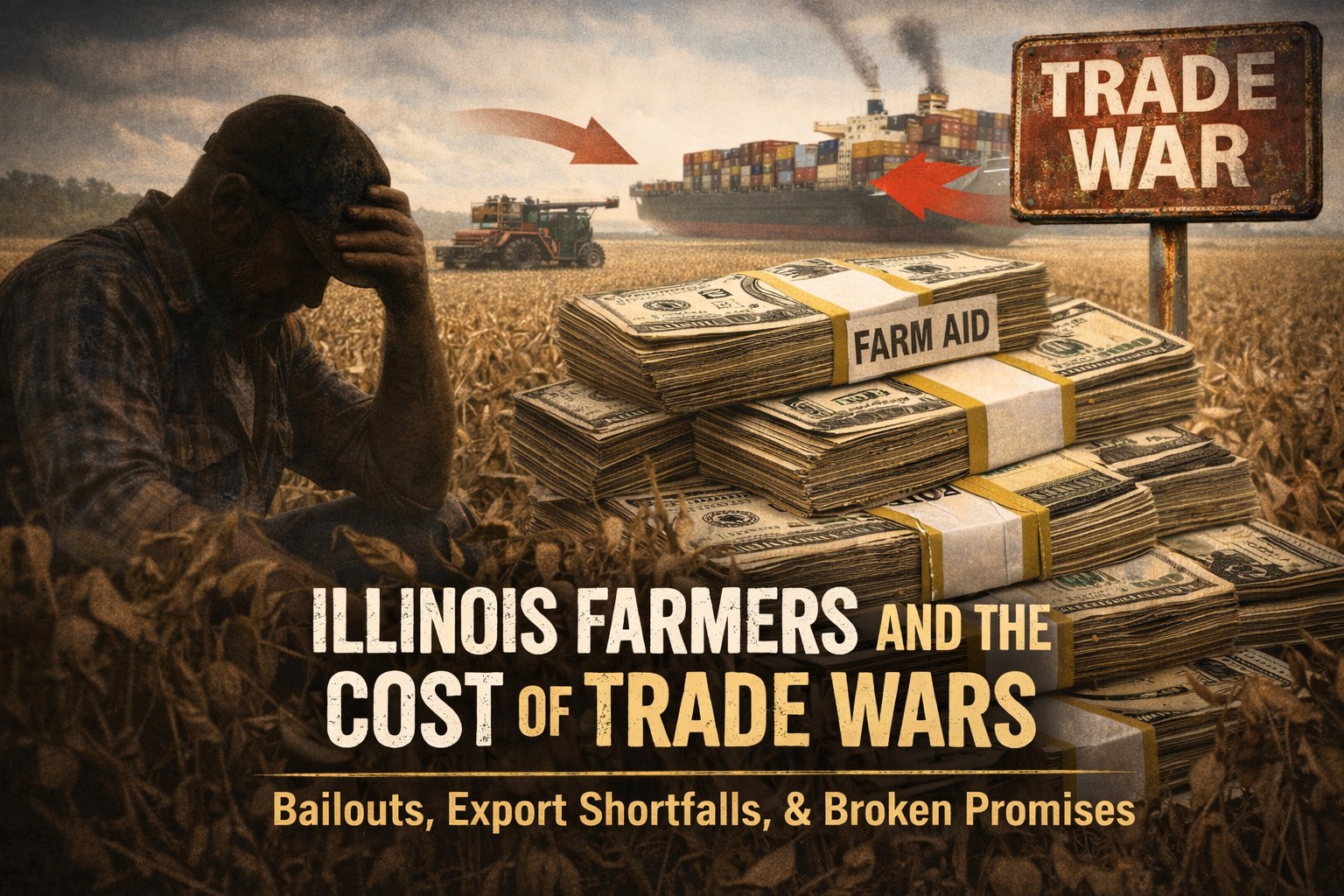
When the United States imposed tariffs on China in 2018, China retaliated by targeting American agriculture — especially soybeans.
Exports collapsed almost overnight.
Soybean prices dropped dramatically as one of the largest buyers in the world turned elsewhere for supply.
To prevent widespread farm bankruptcies, the federal government launched the Market Facilitation Program, ultimately sending roughly $28 billion in emergency payments to farmers.
In other words, federal policy triggered a crisis that required a massive federal bailout to stabilize the farm economy.
Many Republican lawmakers, including Miller, have consistently defended the tariff approach as necessary economic strategy.
But for farmers trying to sell crops into global markets, the policy translated into lost customers and emergency government checks.
Farmers Needed Help Again
The trade war wasn’t the only shock.
When the pandemic disrupted supply chains and commodity markets, farmers once again required federal intervention.
Programs like the Coronavirus Food Assistance Program distributed tens of billions more in emergency payments to agricultural producers across the country.
For many farmers, the past several years have looked like this:
Market disruption → price collapse → emergency federal payments.
That pattern raises a policy question few politicians like to address.
Are these policies strengthening agriculture — or destabilizing it?
The Farm Bill: Who Actually Benefits?
In her email, Miller celebrates advancing a new Farm Bill through the House Agriculture Committee.
Supporting our Farmers
She highlights funding for specialty crops and expanded credit access for new farmers.
But agricultural economists have long pointed out that farm subsidies disproportionately flow to the largest farms and agribusiness operations.
According to USDA data, a relatively small percentage of large farms receive the majority of federal farm payments.
Meanwhile, smaller family farms — the kind politicians love to talk about — often receive far less support.
The result has been decades of consolidation in American agriculture.
Fewer farms.
Bigger operations.
Rural communities slowly hollowing out.
A Controversial Amendment That Alarmed Farmers
Miller has also pushed amendments targeting the hemp industry.
In 2024 she supported an amendment to the farm bill aimed at closing what she described as a loophole allowing THC products derived from hemp to be sold.
But the U.S. Hemp Roundtable warned that the measure could be devastating for hemp farmers, describing it as potentially industry-killing.
For farmers who invested heavily in hemp after legalization in the 2018 Farm Bill, the policy fight created yet another layer of uncertainty.
Politics vs. Farm Economics
Miller’s newsletter focuses heavily on immigration and border policy.
But the issues most farmers say they struggle with daily rarely make it into political messaging:
-
volatile global commodity markets
-
rising fertilizer and fuel costs
-
shrinking export markets
-
supply chain instability
-
consolidation in agriculture
These are the forces shaping the future of farming in Illinois.
And they are driven largely by national policy decisions — trade policy, subsidy structures, and international market access.
Farmers Don’t Need Talking Points
Farmers understand risk better than almost anyone.
Weather risk. Market risk. Equipment costs. Debt cycles.
But what they don’t need is political messaging that glosses over the role Washington policies play in creating those risks.
Illinois farmers have been resilient for generations.
The real question is whether the policies coming out of Washington are helping them succeed — or forcing them to depend on the next round of bailout checks.
Sources
USDA Economic Research Service
Congressional Research Service – Market Facilitation Program
House Agriculture Committee markup discussions
Mary Miller constituent newsletter, March 7, 2026
Supporting our Farmers
Background on Miller farm bill amendment affecting hemp industry